
Enterprise IT has shifted from owning capacity to orchestrating it. Core capabilities like cloud, application development, data, AI/ML, and cybersecurity are often delivered through SOW-based engagements.
According to Staffing Industry Analysts’ Workforce Solutions Buyer Survey 2025, SOW-based engagements now account for 39% of all MSP spend, the highest proportion on record, reinforcing the growing reliance on structured service delivery models. Yet, most IT SOWs still follow a legacy approach that involves focusing on activities, loosely defined deliverables, and generic timelines. That model breaks up the environments where delivery is iterative; architecture evolves quickly, and outcomes matter more than effort.
The result is predictable.
- Projects meet contractual terms but miss business goals
- Costs rise through change requests
- Accountability weakens
In modern IT services, SOW acts as the operating model for execution. When structured well, it aligns architecture with delivery, engineering with business value, and cost with outcomes. When it does not, it creates friction across teams.
The difference is precision, and this blog explores how to bring that precision into IT SOWs.
What is a Statement of Work (SOW)?
An SOW is a formal document that defines the scope, deliverables, timelines, responsibilities, and acceptance criteria for a service engagement. It acts as the operational framework that governs how work is executed and evaluated between a buyer and a vendor.
Add something more here: Key Components maybe
Three Types of SOWs
- Design/Detail SOW: This prescribes how the work will be done. Common in highly regulated industries or where the buyer has specific process requirements. You get exactly what you specified, not necessarily what you need.
- Performance-based SOW: This defines desired outcomes and standards without prescribing methods. The US federal government moved toward this model following the Government Performance and Results Act precisely because prescriptive SOWs were generating compliance without value. This model gives vendors flexibility to innovate but demands rigorous acceptance criteria from the buyer.
- Level of Effort SOW: This specifies the time and resources to be applied rather than outcomes. This is appropriate for advisory relationships and time-and-materials engagements, but this also brings highest risk for scope control.
What Is a Statement of Work (SOW) in Service Procurement?
An SOW is the governing delivery document for service engagement. It specifies what will be done, by whom, under what conditions, and to what standard. It is not the contract itself, but the operational core that gives meaning to the contractual terms. Without a strong SOW, a contract is a legal shell around an undefined promise.
A rigorous SOW also specifies what the buyer must provide, like access, data, approvals, and personnel, because service delivery is bilateral. Vendors can only deliver what the engagement environment permits them to deliver.
When to Use an SOW
Not every vendor engagement requires full SOW. Routine procurement such as standard goods, catalogue-based services, or short-duration transactions is typically governed by a purchase order. An SOW becomes essential when the engagement involves:
- Defined but complex deliverables with quality standards that must be verified
- Multi-phase execution where dependencies create sequencing risk
- Third-party vendors or independent contractors delivering services that integrate into internal operations
- Engagements where the outcome directly ties to revenue, compliance, or strategic milestones
- Any situation where scope creep would be commercially significant
The common error is treating an SOW as optional for ‘smaller’ engagements. Scope disputes are not proportional to contract value. A poorly structured SOW for a $200,000 professional services engagement can cost more to resolve management time, rework, and legal exposure than the engagement itself was worth.
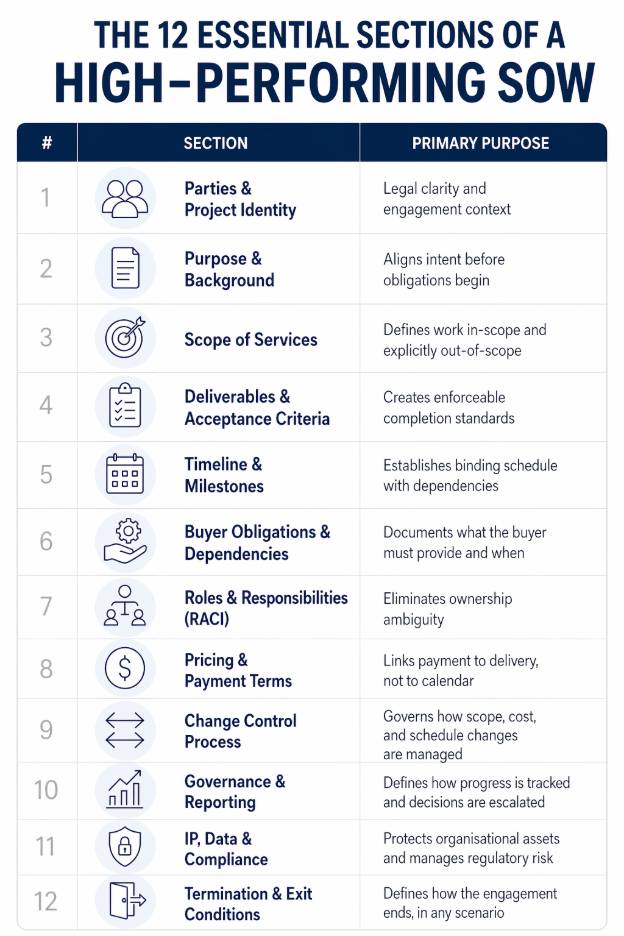
How to Write a Statement of Work: 12 Essential Sections of an SOW
A well-structured SOW is a control framework. While the specifics vary across IT engagements, the underlying structure remains consistent. The following sections define what a robust, enforceable SOW should include.
Section 1: Parties & Project Identity
Include legal names of both parties, effective date, project title, SOW reference number, and the governing master agreement. This establishes the legal foundation for all obligations.
Section 2: Purpose & Background
Summarize the business context, objectives, and key assumptions at the time of signing. This section helps interpret intent if disputes arise.
Section 3: Scope of Services
Clearly define what is in scope, out of scope, and the assumptions involved. Assumptions act as dependencies. If they change, it should trigger formal change control.
Section 4: Deliverables & Acceptance Criteria
For each delivery, specify description, format, owner, timeline, and objective acceptance criteria. Also define approval timelines, revision cycles, and what happens if deliverables are rejected.
Section 5: Timeline & Milestones
Outline milestones, dependencies, and linked deliverables. Distinguish between fixed milestones and those dependent on external inputs to ensure fair accountability.
Section 6: Buyer Obligations & Dependencies
List everything the buyer must provide, like access, data, approvals, and timelines. This prevents delays caused by unmet dependencies and clarifies shared responsibility.
Section 7: Roles & Responsibilities (RACI)
Define ownership using a RACI model for key activities and decisions. Clearly establish approval authority and escalation thresholds.
Section 8: Pricing & Payment Terms
Detail pricing structure and tie payments to milestones or deliverable acceptance; every detail should be present in the SOW. Include invoicing terms, expense policies, and handling of rejected deliverables.
Section 9: Change Control Process
Define how changes are raised, evaluated, approved, and implemented. A structured process ensures changes are managed and not negotiated with ad hoc.
Section 10: Governance & Reporting
Establish review forums, reporting frequency, and escalation paths. Define who meets, how often, and what decisions each level can make.
Section 11: IP, Data & Compliance
Clarify ownership of intellectual property, data handling requirements, and compliance standards. Tailor this section to specific engagement, not generic clauses.
Section 12: Termination & Exit Conditions
Define exit scenarios, including termination for convenience or cause, and outline payment, transition, and knowledge transfer obligations. A clear exit framework strengthens accountability throughout the engagement.
The 7 Most Common SOW Mistakes That Derail Service Procurement
Most SOW failures are predictable. The same structural mistakes repeat across engagements, and they are the primary drivers of cost overruns, delays, and delivery disputes. The same structural mistakes show up across industries, vendors, and deal sizes. Recognizing them is where better procurement begins.
-
Vague scope without clear exclusions
Most SOWs describe what is included but fail to define what is not. That gap creates room for interpretation and eventually changes requests. Clear exclusions are not restrictive, but they protect commercial clarity.
-
Deliverables without acceptance criteria
A deliverable is only meaningful if it can be measured. Without defined approval standards, vendors can claim completion while buyers struggle to enforce quality. This is where most disputes begin.
-
Loose timelines and undefined milestones
Broad timelines without structured milestones weaken accountability on both sides. Progress becomes difficult to track, and delays surface too late to correct.
-
No formal change control process
Change is inevitable in any complex engagement. Without a structured mechanism to manage scope, cost, and timelines, every change turns into a negotiation and usually an expensive one.
-
Missing buyer obligations
SOWs often focus only on vendor responsibilities. But delivery depends equally on buyer access to systems, timely approvals, and stakeholder availability. When these are not defined, delays become inevitable and accountability gets blurred.
-
Weak governance and escalation structure
Without clear decision-making authority and escalation paths, issues either linger unresolved or escalate unnecessarily. Both slow down delivery and strain working relationships.
-
Ignoring IP, data, and compliance risks
In IT and digital services, vendors interact with sensitive data and create valuable intellectual property. Treating these as standard legal clauses instead of engagement-specific requirements exposes the organization to significant risk.
Step-by-Step Process: How to Build a Bulletproof SOW Every Time
A strong SOW is built through structured thinking. Most SOW failures begin before drafting, especially when scope is unclear; dependencies are missed, and expectations are not aligned. The steps below bring discipline to that process, ensuring clarity, accountability, and alignment before anything is put on paper.
-
Step 1. Start with the business problemDefine the outcome, not the solution. If the problem is unclear, the SOW will only formalize confusion.
-
Step 2. Map buyer dependencies earlyIdentify what the vendor needs from you like the data, access, and decisions. Most delays originate here, not with the vendor.
-
Step 3. Build scope collaborativelyProcurement cannot define execution alone. Validate scope with the teams who will run and use it.
-
Step 4. Define acceptance before deliverablesIf you cannot define how success will be measured, you are not ready to define what will be delivered.
-
Step 5. Structure milestones around dependenciesTimelines are sequences. Define what must happen, in what order, and by whom.
-
Step 6. Anchor ownership through roles, not namesPeople change. Roles do not. Define accountability structurally, then map individuals.
-
Step 7. Tie pricing to outcomesPayments should follow delivery, not time. This is where accountability becomes real.
-
Step 8. Operationalize change controlDo not describe it instead design it. Ensure change management is a working process with clear steps and ownership and not just contractual language.
-
Step 9. Involve legal earlyLate-stage legal intervention slows deals and weakens alignment. Involve them while the structure is still flexible.
-
Step 10. Align with the vendor before signingWalk through the SOW together. Misalignment caught early is easy to fix, which can later become costly.
-
Step 11. Set up governance before executionSet up reviews, reporting, and escalation beforehand. Governance only works when it is actively managed.
-
Step 12. Revalidate mid-engagementLong engagements drift. A structured review ensures that the SOW still reflects reality, not just what was signed.
Advanced Best Practices for Enforceable, Modern SOWs
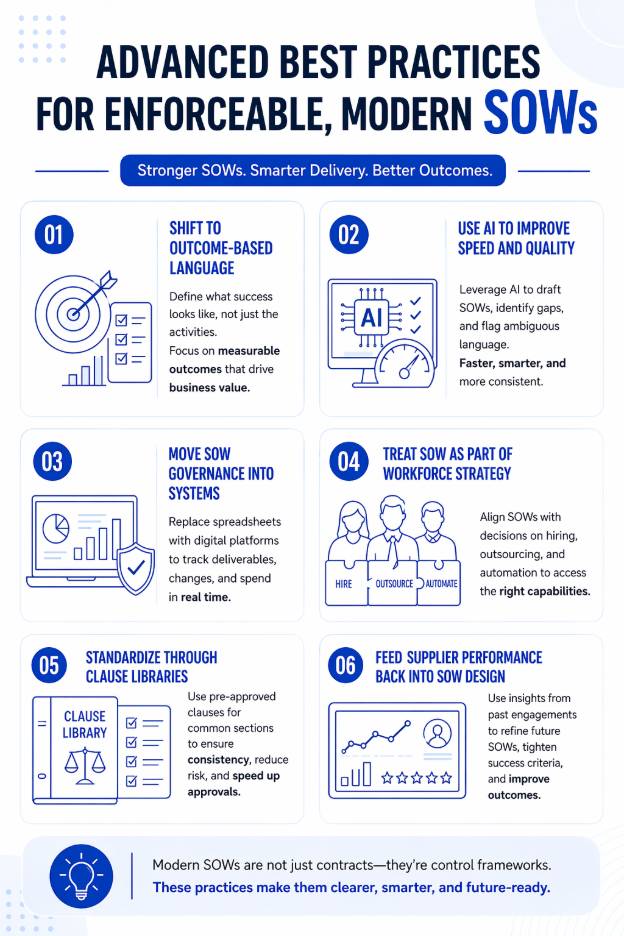
The fundamentals of a good SOW are well established. What differentiates high-performing organizations is how they extend them, treating the SOW as a strategic control mechanism, not just a contract. Here are some of the SOW best practices that you should keep in mind:
-
Shift to outcome-based languageDefine what must be achieved, not just what will be done. Activities can be completed without impact, but outcomes cannot be.
-
Use AI to improve speed and qualityAI tools can be used to draft SOWs, identify gaps, and flag ambiguous language. They do not replace discipline, but they make it scalable and consistent.
Everest Group research Identifies AI-driven SOW authoring and supplier matching as two of the five transformative shifts in services procurement for 2025 and beyond. -
Move SOW governance into systemsSpreadsheets to limit visibility. Leading organizations use platforms to track milestones, deliverables, change requests, and spend more in real time enabling better control.
-
Treat SOW as part of workforce strategySOW is not just procurement but a way to access capability. It should align with decisions on hiring, outsourcing, and automation.
-
Standardize through clause librariesPre-approved language for common sections improves consistency, reduces drafting time, and minimizes legal friction.
-
Feed supplier performance back into SOW designUse past engagement data to refine future SOWs, tighten acceptance criteria, adjust milestones, and address recurring gaps.
Conclusion & Next Steps
The Statement of Work is one of the most critical documents in IT-based service procurement and one of the least disciplined. The difference between a SOW that governs outcomes and one that simply documents intent comes down to structure, clarity, and enforceability.
Leading organizations treat SOW quality as a capability. They standardize what works, integrate governance into systems, and continuously improve based on past performance. Most importantly, they treat SOW as a shared commitment, not just a vendor’s obligation.
What you should do next:
- Audit your recent SOWs: Identify recurring gaps in scope, acceptance, and change control
- Introduce cross-functional reviews: Align procurement, IT, finance, and legal before execution
- Standardize key clauses: Reduce inconsistency and speed up approvals
- Evaluate your governance approach: Ensure you have visibility beyond spreadsheets
- Learn from past engagements: Use real outcomes to strengthen future SOWs
Service procurement will only become more central to how organizations deliver. The SOW will carry that weight whether it is designed or not.